See who shapes EU law, where the fight is, and what is coming.
EURVISTA assembles the working record of the European Parliament, the Council of the EU and the European Commission into one searchable corpus, and shows you the evidence behind every answer. Built for people who need the source document, not a summary of someone else’s summary.
EURVISTA is in closed beta and access is by invitation. It is a research project at University College Dublin, funded by the ARC Hub Translational Research Programme.
What is in the corpus
- Legislative files
- Documents
- Recorded votes
- Individual vote casts
- Amendments
- Declared lobby meetings
- Consultation submissions
- Registered organisations
Counts refresh with the extracts. See data & coverage for what is held, how far back, and what is not.
Four things the record can answer that a news alert cannot
Every screen below is a real page from the platform, rendering real extracts.
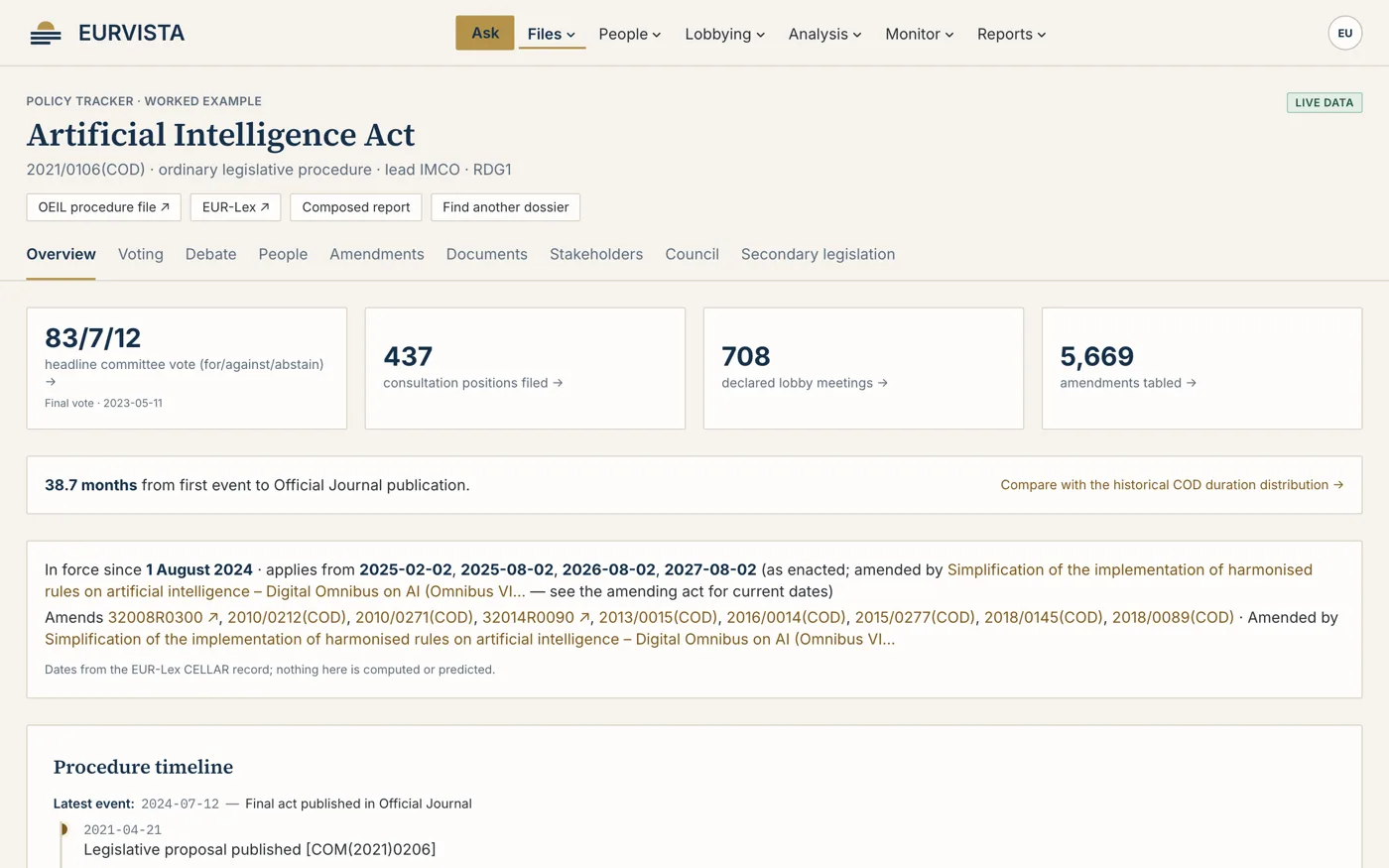
Follow a file from proposal to national law
One page per legislative file: the procedure timeline, committee and plenary stages, the amendments tabled against it, the Council positions recorded on it, and which member states have notified implementing measures.
- Rapporteurs, shadows and committee opinions, with roles dated
- Recorded votes at committee and in plenary, with the roster
- Every document version, linked to its source register
Know what changed while you were asleep
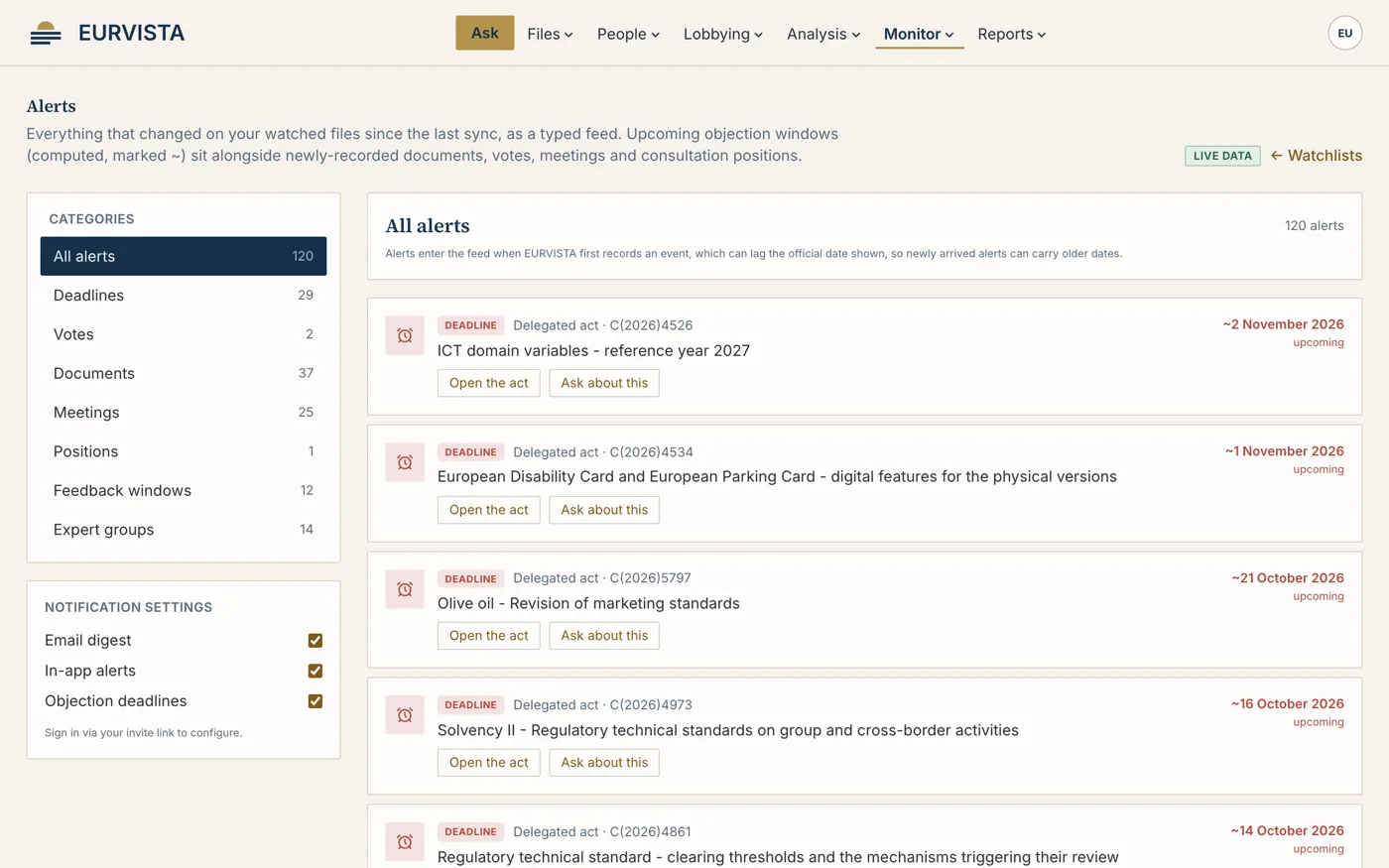
Watch the files, members, organisations and topics you care about. Every change arrives as a typed event you can filter: new documents, recorded votes, declared meetings, consultation submissions and scrutiny deadlines. The morning brief groups the same events by file.
- Typed events, each linked to the record that produced it
- Objection windows on delegated and implementing acts, computed and labelled as such
- A daily digest by e-mail, or nothing at all
See who is being heard, and by whom
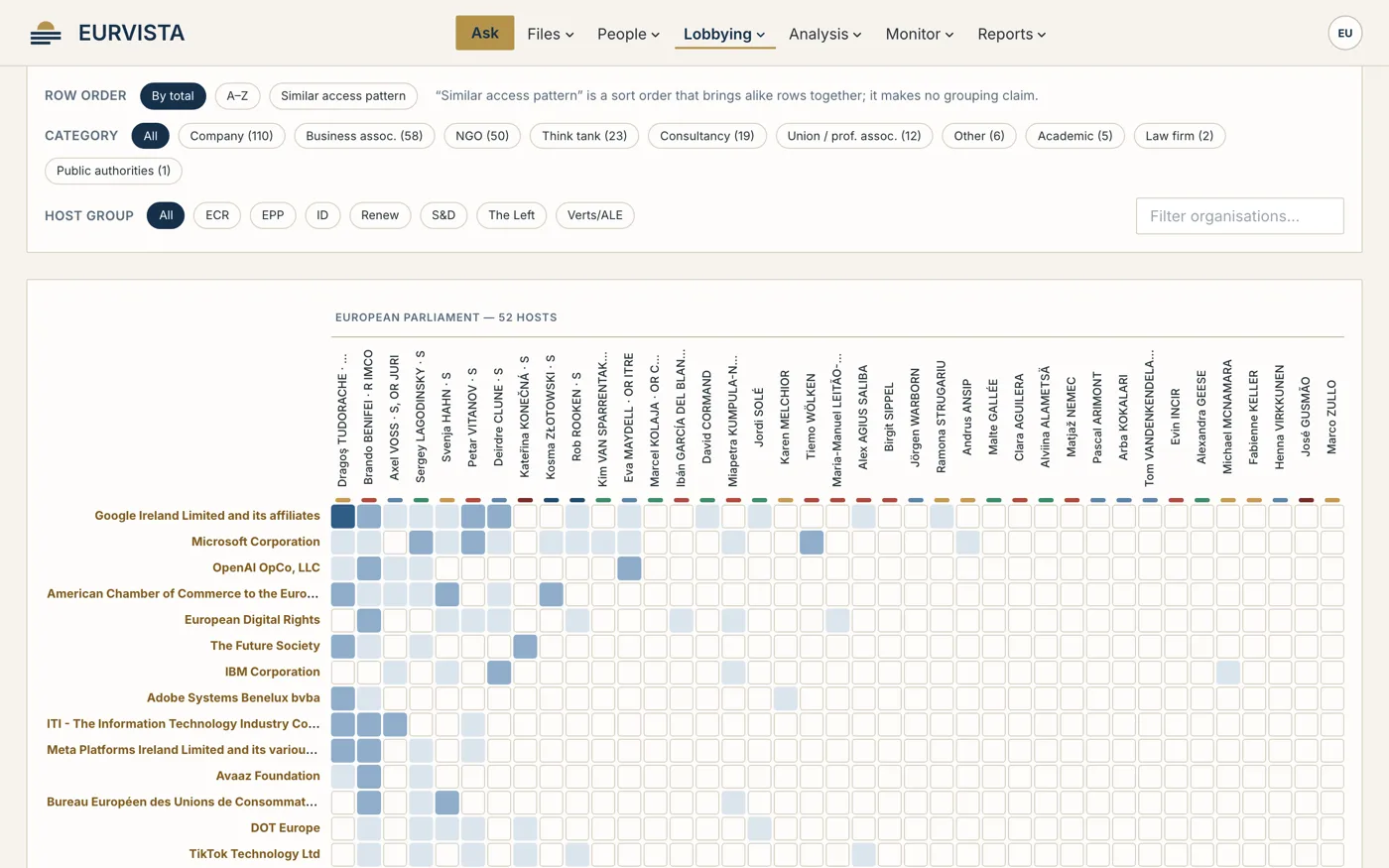
Declared meetings from both the Parliament and the Commission, resolved to the EU Transparency Register, laid out per file and per topic. Consultation submissions read in full, attributed to the organisation that filed them.
- Which organisations met which hosts, on which file, and when
- Share of declared meetings on a topic, against a benchmark you choose
- Coverage stated openly where the source register is incomplete
Read the record itself, not a paraphrase of it
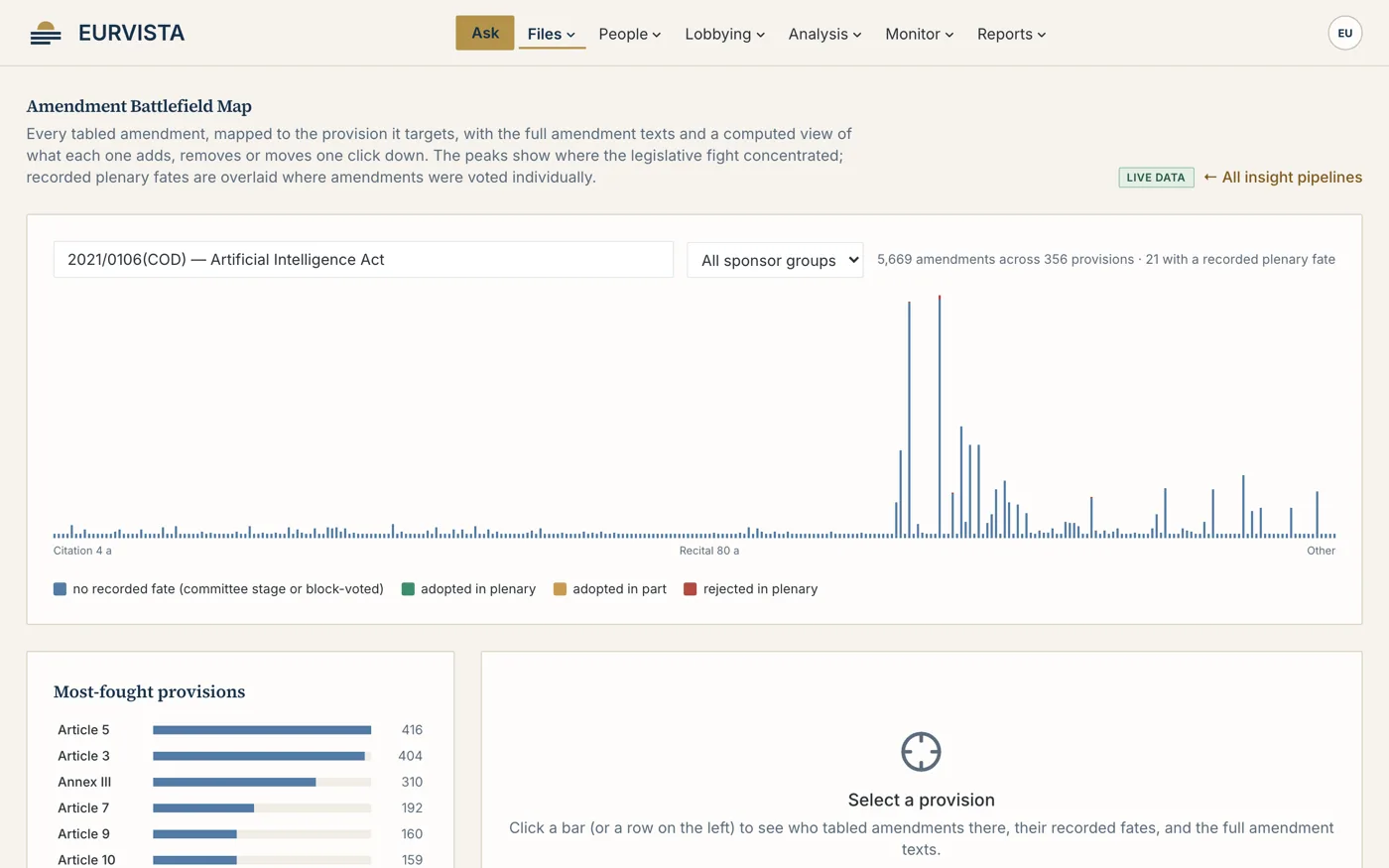
Amendment texts, plenary speeches, parliamentary questions and the answers to them, consultation submissions and Council documents, held verbatim and attributed to their source. Where a document is a scan, it has been read and the text checked, not guessed at.
- Amendments mapped to the provision they change, so you can see where the pressure fell
- Speeches linked to the file under debate
- A link to the original register entry on every record
Three jobs, one corpus
Public affairs and government relations
Monitor a portfolio of files without reading every register by hand. Find the members and committees that matter on a file, see who else has been in the room, and know when the next entry point falls. Take the citation into the briefing with you.
Journalists and civil society
Trace a provision back to the amendment that changed it and the member who tabled it. Compare declared access across organisations on a file. Every figure on screen resolves to a public register entry you can check and cite.
Researchers and analysts
Work across institutions on one joined corpus rather than six incompatible exports. Vote casts, amendments, meetings, submissions and transposition measures share a spine, and coverage limits are stated rather than smoothed over.
Why the answers hold
A policy tool that guesses is worse than no tool, because a confident wrong answer is repeated. These are the rules the platform is built to, and they cost it capability on purpose.
Every claim carries its source
Each record links to the register entry it came from, with the date it was extracted. If you cannot check it, we do not assert it.
Bands, not scores
Influence is reported as an ordinal band with the evidence behind it spelled out, and the formula is versioned. There is no numeric influence score, because the precision would be invented.
Base rates, not predictions
Where the platform reports how often something has happened, it names the cohort and the period. It does not forecast dates or attach probabilities to outcomes.
Gaps stated, not hidden
Where a source register is incomplete, the page says so and gives the coverage figure. Peripheral matches are shown and marked rather than quietly dropped.
Third-party texts verbatim
Amendments, submissions, speeches and answers are held and shown as written, attributed to whoever wrote them. They are never paraphrased into our own words.
Nothing tracks you
No cookies beyond the one that keeps you signed in, no analytics scripts, no advertising or social pixels. Every font, script and image is served from our own machine, so loading a EURVISTA page contacts no other company.
A research project, running as a product
EURVISTA is developed at the Connected_Politics Lab and the School of Politics and International Relations at University College Dublin, with Rinn AI, the Research Ireland Centre for Research and Innovation in Data Science and AI. It is funded by the ARC Hub Translational Research Programme.
The methods it applies to the legislative record were developed and peer reviewed first. The platform is what happens when that work is turned into something usable by people outside a university.
Request beta access
Access is by invitation while the platform is in development. Tell us who you are and what you would use it for, and we will reply by e-mail. We are particularly interested in hearing from public affairs teams, journalists and researchers willing to tell us where it falls short.
Already invited? Beta login