What the platform does
EURVISTA is one corpus with several ways into it. This page walks through them in the order a public affairs reader tends to need them: what changed, then what is in the file, then who else is working on it, then who decides, then what you hand to someone else.
Screens below are the real pages, rendering real extracts, unless marked otherwise. Where a surface is still a design for something not yet built, it says so and carries an Illustrative tag on the page itself.
What changed, and what is coming
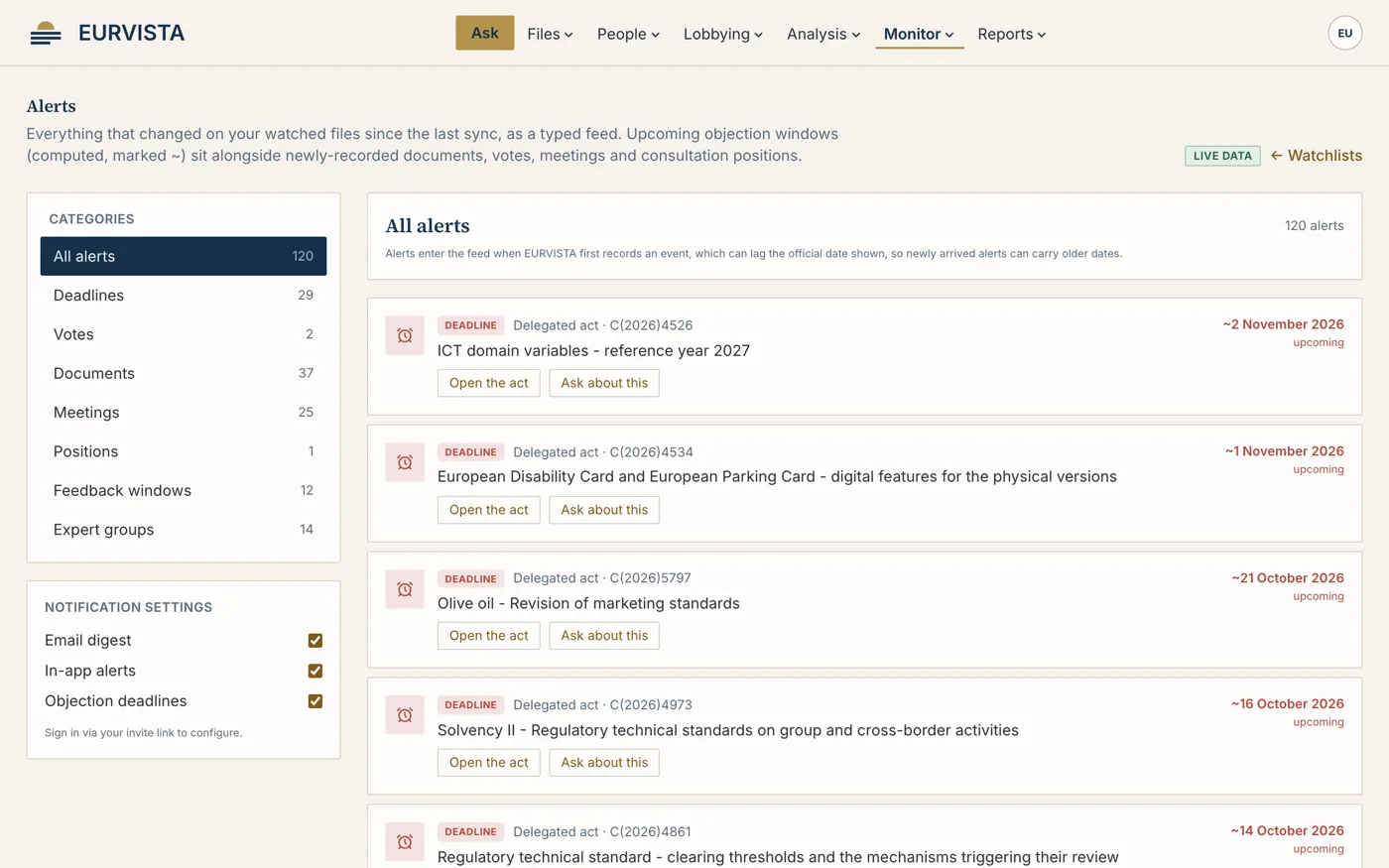
Watchlists, alerts and the morning brief
Watch four kinds of thing: a legislative file, a member, a registered organisation, or a topic. The alerts feed types every change and lets you filter by kind; the morning brief groups the same events by file, so a portfolio of thirty files reads as one page rather than thirty tabs.
- Typed events: documents, votes, meetings, submissions, stage changes
- Each event links straight to the record that produced it
- A daily e-mail digest, opt-in, with a one-click unsubscribe
Live data
The entry-point calendar and the comitology radar
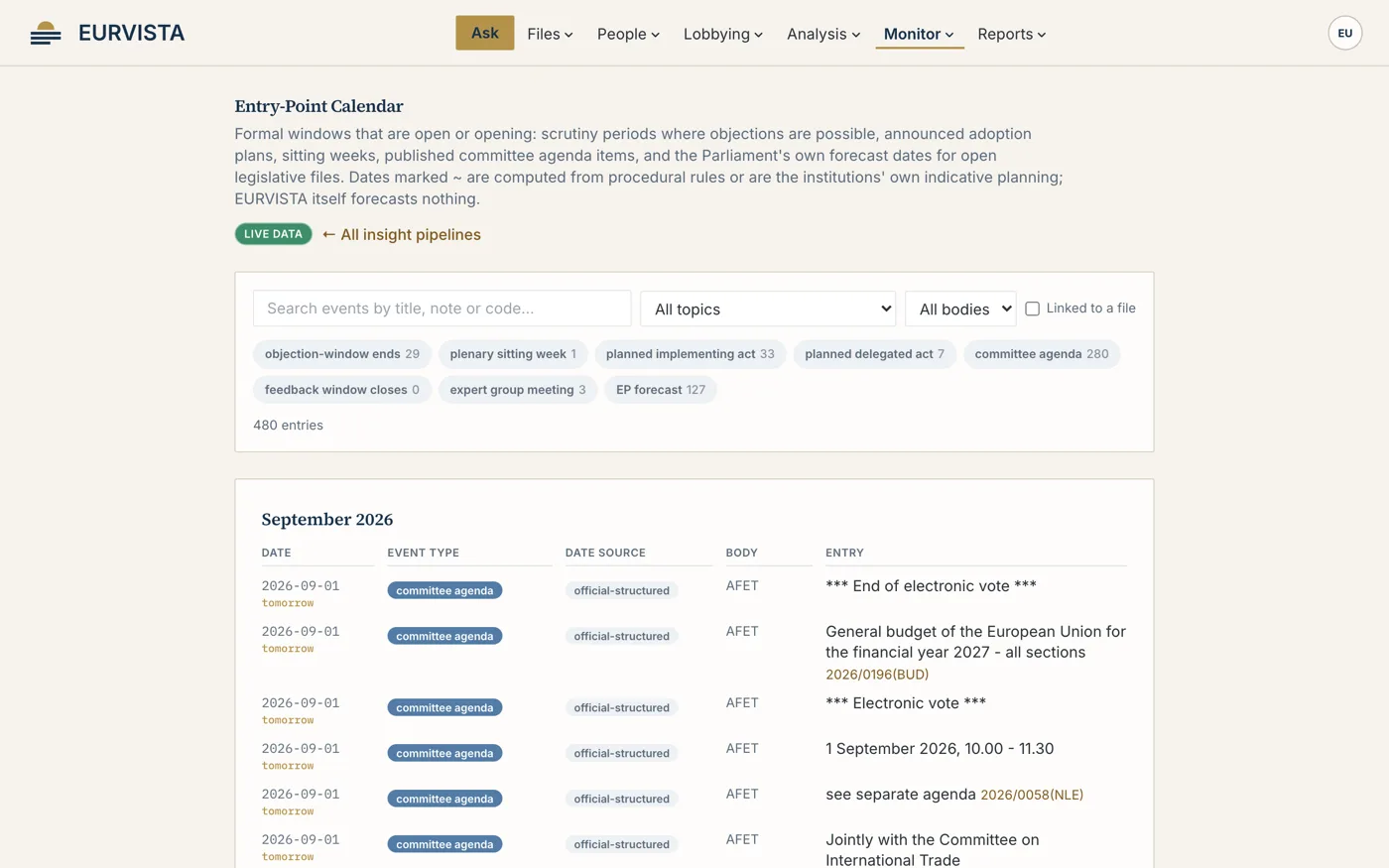
Most of the moments where a file can still be influenced are procedural and are published in advance. The calendar collects them: objection windows on delegated and implementing acts, planned adoptions, and sitting weeks.
- Objection deadlines computed from the notification date and marked as computed, never presented as announcements
- Acts still in scrutiny, with their latest committee vote
- Early-warning signals: where parliamentary questions and floor time are concentrating before anything is proposed
Live data
One legislative file, end to end
The file page
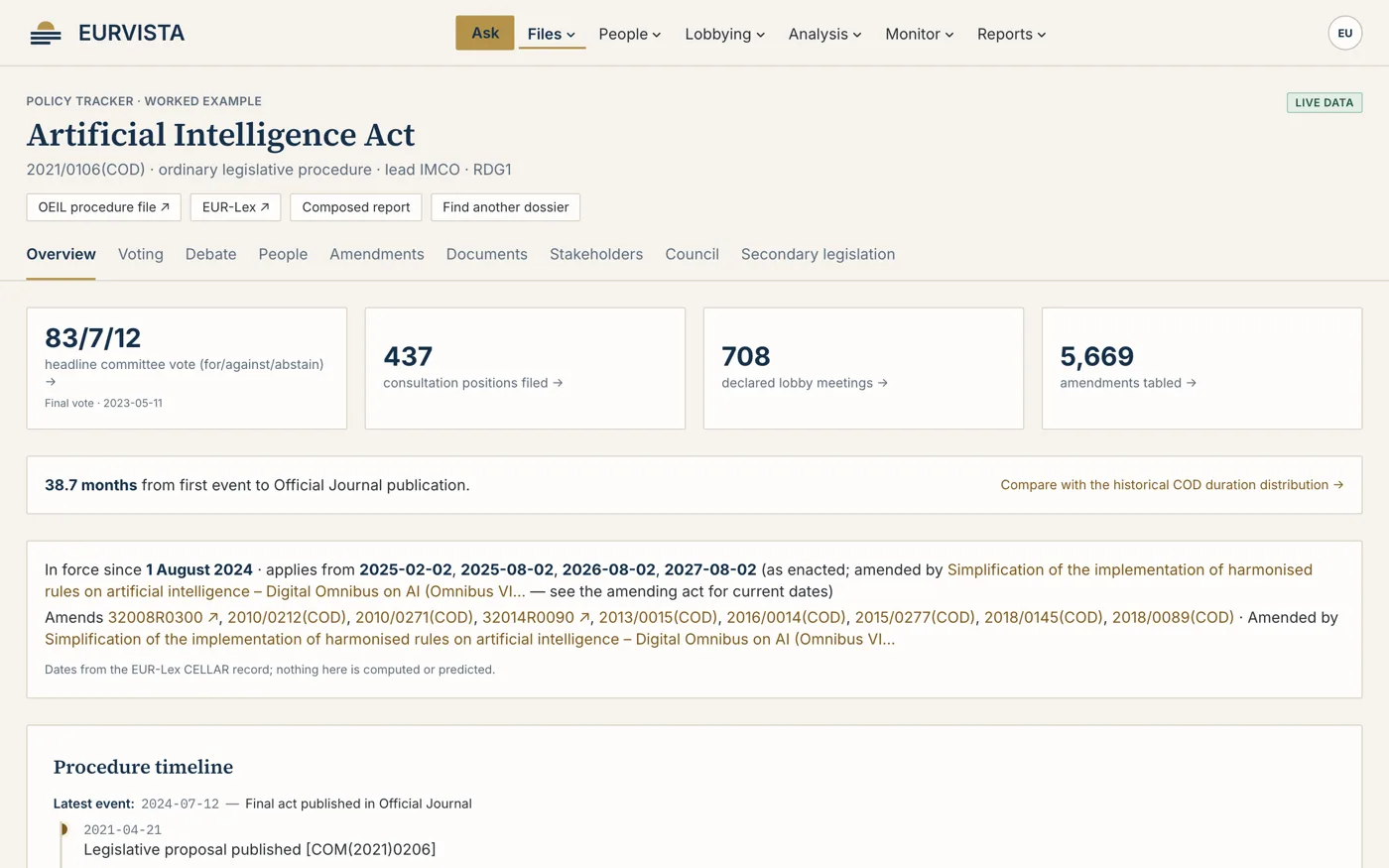
Every legislative procedure in the corpus has the same page: the timeline, the Parliament side, the stakeholders, the amendments, the Council side, and the national measures that followed. There is no separate treatment for the files we happen to have studied.
- Procedure events dated from the source register
- Rapporteurs, shadows and committee opinions, with roles dated
- Recorded committee and plenary votes, with the roster and the group tallies at the time of the vote
- Council positions and the majority arithmetic where it was released
Live data
The amendment map
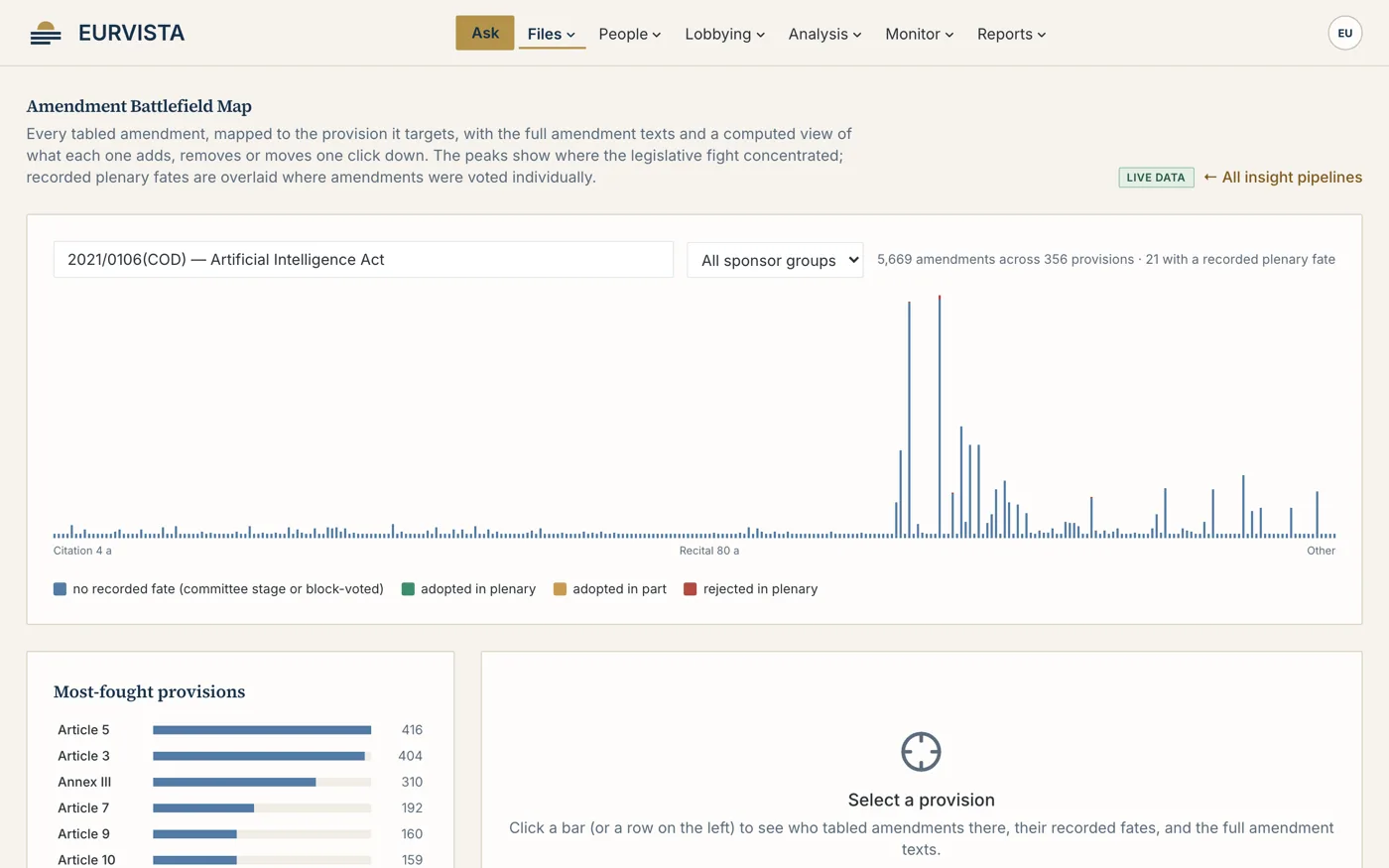
Amendments mapped to the provision they change, so you can see which articles drew the pressure rather than reading a thousand-page tabling document to find out. Verbatim texts sit beneath, with a diff against the text they amend.
- Pressure by provision, from the amendment’s own article reference
- Plenary outcomes overlaid where an amendment was individually voted
- Full texts, attributed to the members who tabled them
Live data
Consultation submissions
What organisations actually wrote in a public consultation, read in full and attributed, with a link back to the Commission’s own feedback page.
National transposition
Which member states have notified implementing measures for a directive, and which have not, drawn from EUR-Lex.
Base rates
How often amendments from a given group or committee have been adopted historically, and how long procedures of a given type have taken. Named cohorts and periods, never a forecast.
Who is being heard
Declared meetings, resolved to the register
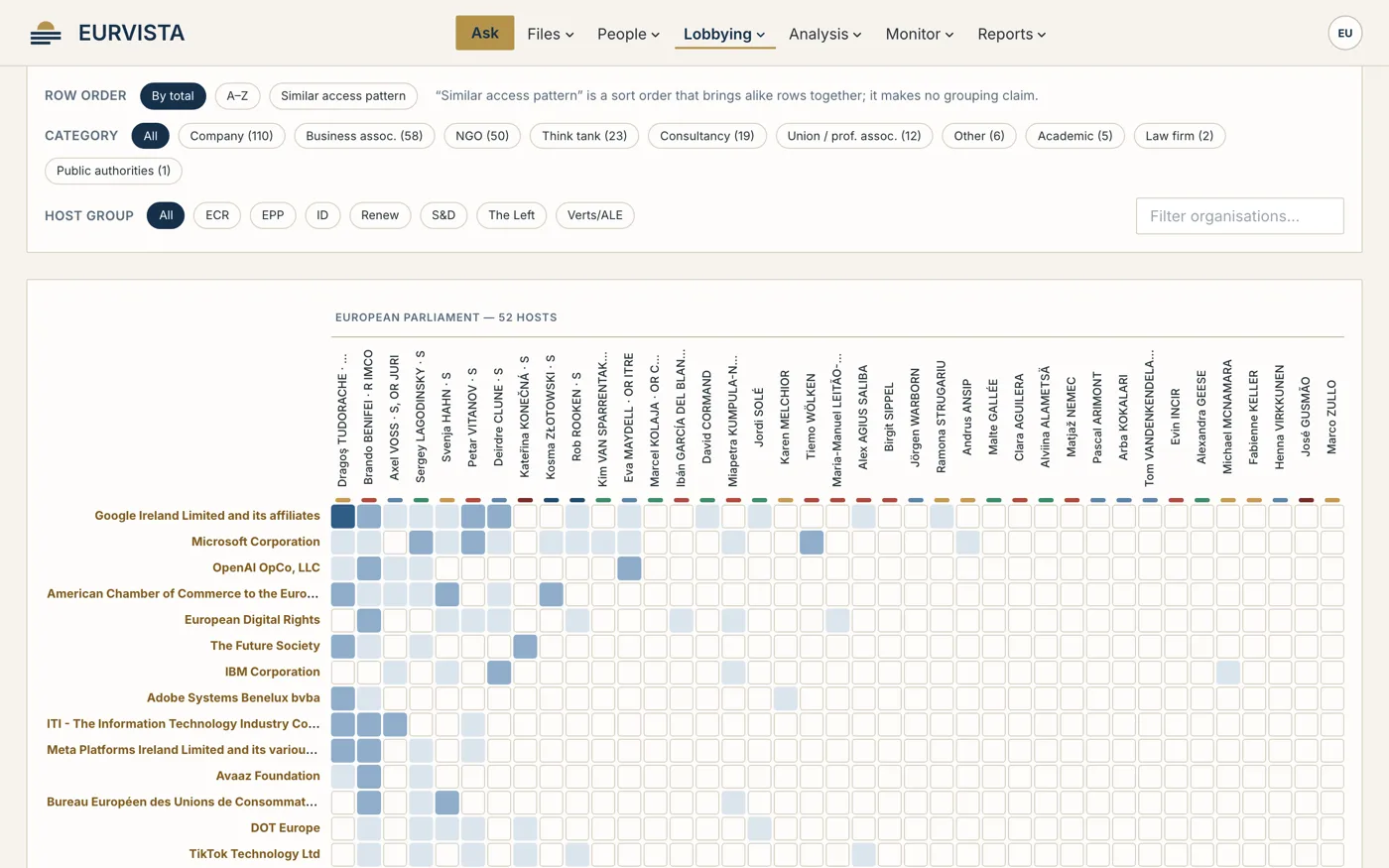
Meetings declared by members of the European Parliament and by the Commission, matched to the EU Transparency Register so an organisation reads as one entity rather than as a dozen spellings of its name.
- Access matrix: every organisation against every host, on one file
- Access timeline: when those meetings fell against the procedure calendar
- Share of voice: who is being met on a topic, against a benchmark you pick
- Organisation profiles with declared goals, costs and staff numbers from the register
Live data
What this is not
Declared meetings are a record of what was declared, not a complete record of who spoke to whom. Declaration obligations differ between institutions and between office-holders, and a substantial share of attendee rows in the source data carry no register number at all. The platform states that coverage figure on the page rather than presenting a partial count as a total. Where organisations have argued the same way on a file, the platform says their positions were aligned. It does not call them a coalition, because the record does not show co-ordination.
Who decides, and how they have voted
Member profiles
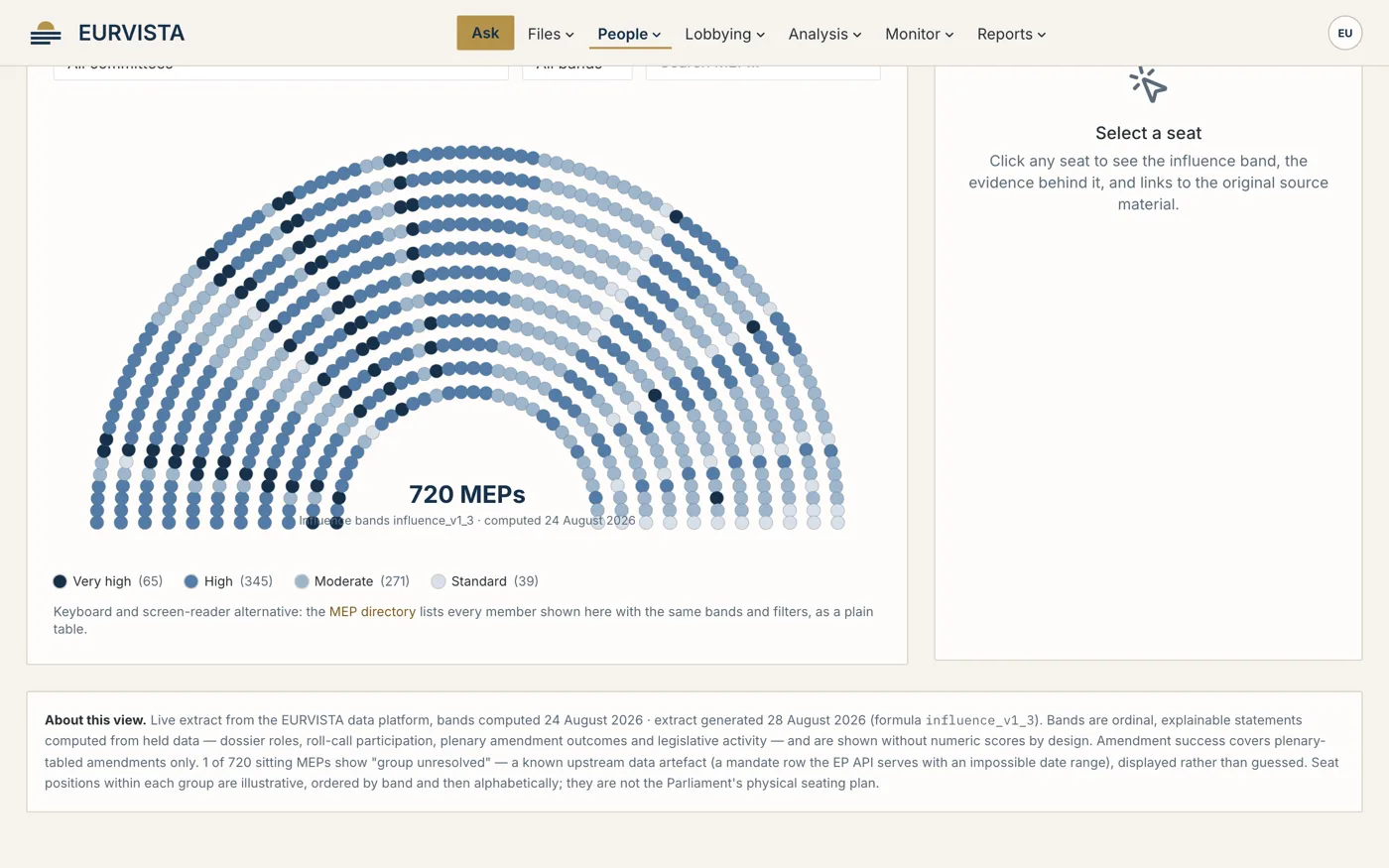
A profile per member: their voting record, activity over time, committee and rapporteur roles, the files they have handled, who they collaborate with, and the meetings they have declared. Focus the whole profile on a single file when you only care about one.
- Voting mix and loyalty to their group, measured against that group’s own cohesion
- Agreement with the house majority, computed from the vote record
- Policy focus by area, counted from the files they have held, never framed as expertise or as a position
- Speeches, questions and the answers to them, verbatim
Live data
Votes, at every level
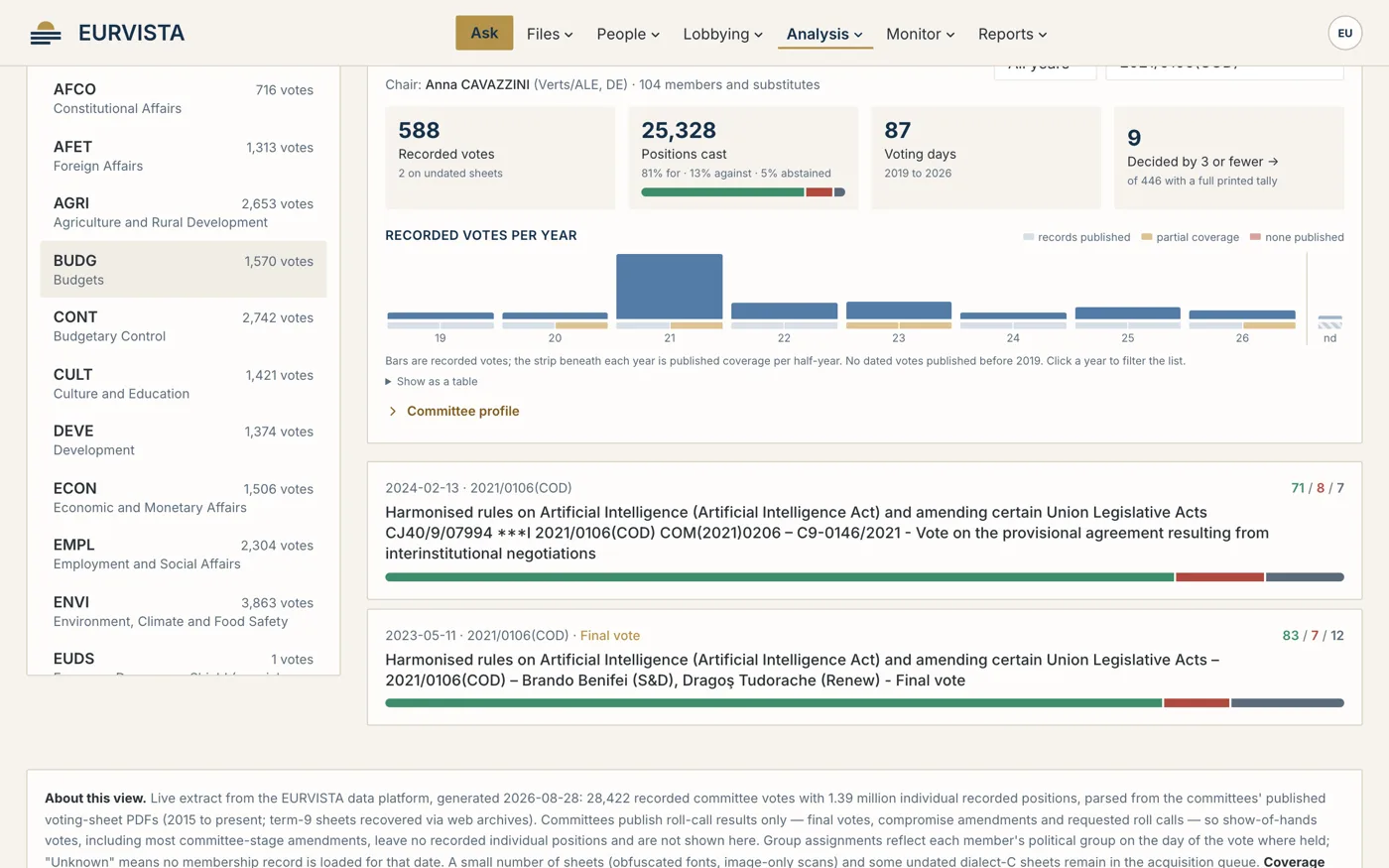
Recorded votes in committee and in plenary, individual casts by member, group breakdowns at the time of the vote, Council positions by member state, and votes in the comitology committees where implementing acts are settled.
- Committee roll calls with a link to the source voting sheet
- Group cohesion, and the members who most often diverge from their group’s line, reported descriptively
- Council dissent by state and year, and the recent contested votes
Live data
What you hand to someone else
Composed briefings
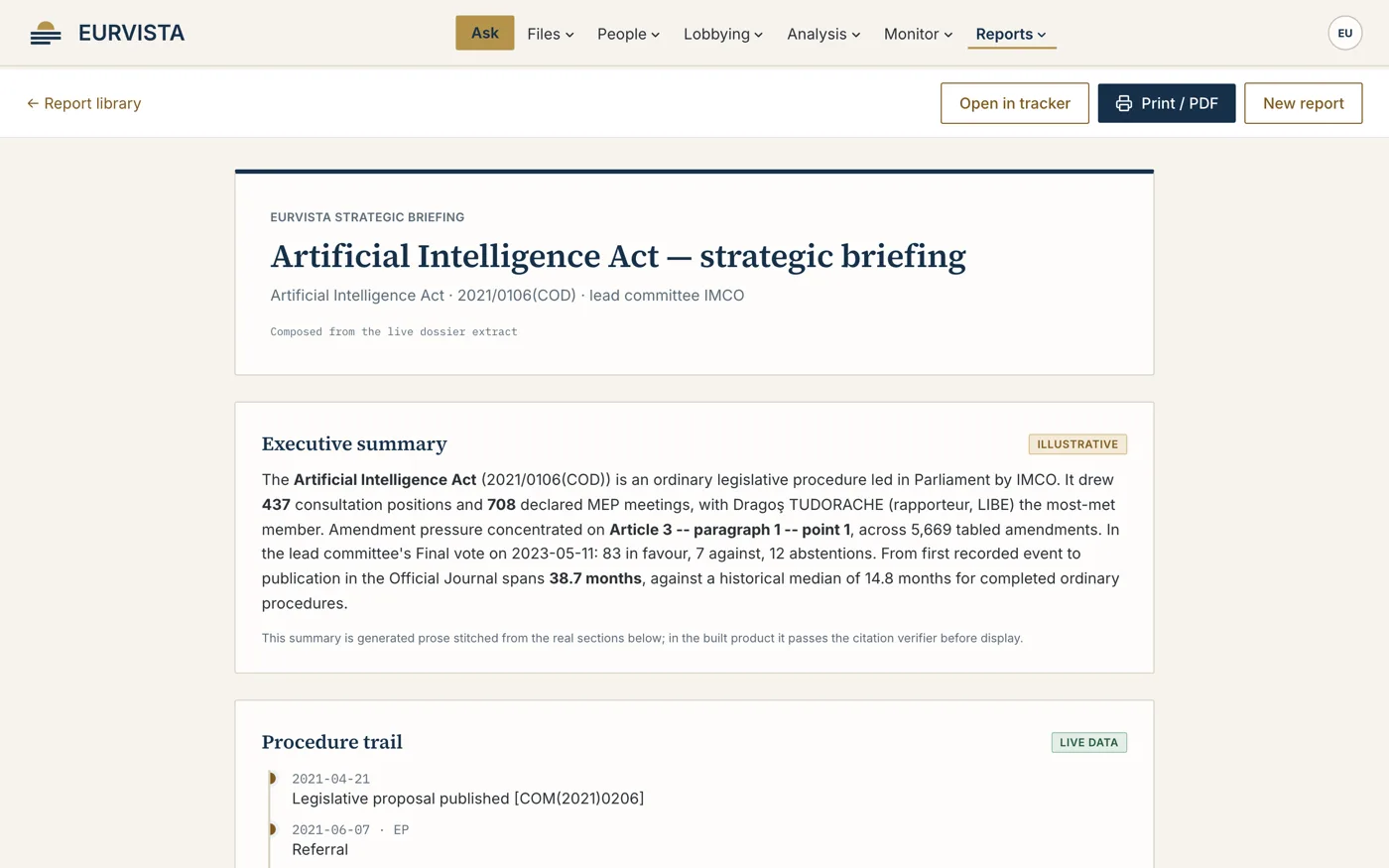
Pick a file and the sections you need, and the platform composes a briefing from the record: state of play, the Parliament side, stakeholders, amendments, the Council side, timing. Every section carries the source and the extraction date, so the document survives being forwarded.
Live data Illustrative
Sections are composed from real records. Generated executive summaries are marked illustrative until the verified generation layer ships.
On the question-answering layer
EURVISTA is designed to answer questions in plain language over this corpus, with every sentence carrying the records it rests on and an audit trail behind it. That layer is in development. The platform currently ships a worked example of the answer experience, marked illustrative, in which the prose and the confidence statements are written by hand while every cited record is real and checkable. We would rather show you the shape of it honestly than ship an answering layer that is confidently wrong about EU law.
Try it on your own files
Access is by invitation while the platform is in development. Tell us what you work on and we will reply by e-mail.